
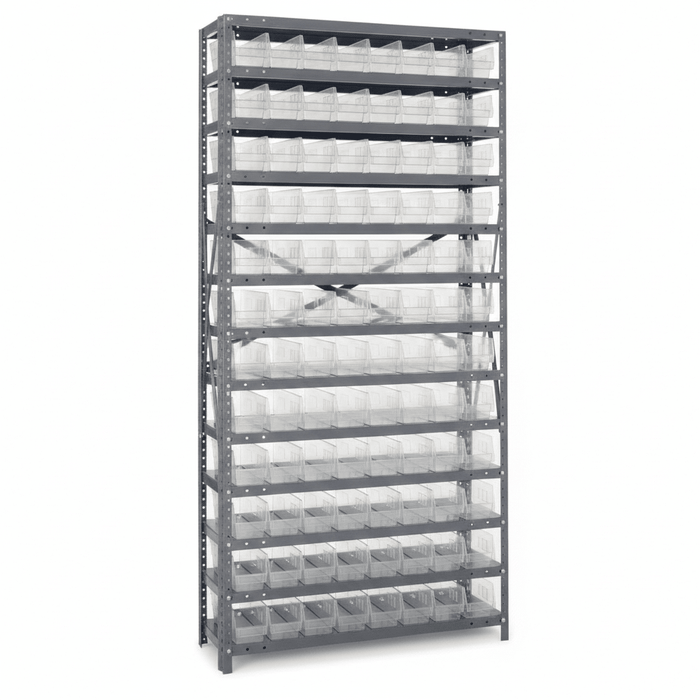
Stationary clear-bin shelving
For permanent vault storage. Choose 96 narrow, 60 medium or 48 wide bins.
From $710.49
Choose your binsClear bins, ready-made shelving and a layout that works for your dispensary.
Two complete shelving-and-bin setups, ready to organize your inventory.
For permanent vault storage. Choose 96 narrow, 60 medium or 48 wide bins.
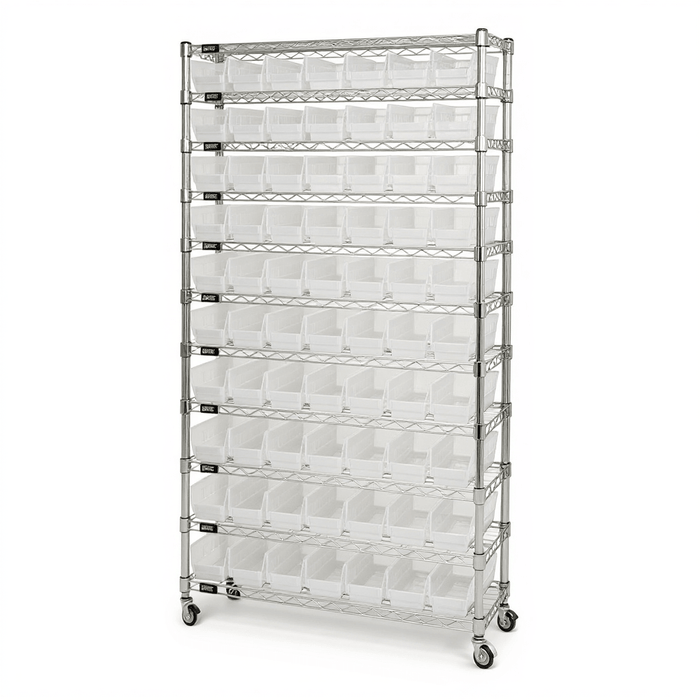
For inventory that moves. 57 clear bins on a rolling wire cart.
Choose bins, containers and shelving for the rest of your operation.

Add pick locations to existing shelving.

Separate small SKUs into adjustable compartments.

Organize reserve stock and sealed packages.

Put available wall space to work.

Create room for cases and larger inventory.
Turn your usable wall dimensions into a shelving layout. Choose your bin mix and explore a plan for your vault.
Clear access to your inventory


Straight answers about how to physically store flower, pre-rolls, vapes, concentrates, edibles, tinctures, backstock and supplies in dispensary vaults, inventory rooms and behind-the-counter areas. These recommendations focus on the physical storage layer: bins, containers, shelving, SKU locations, replenishment and space utilization.
Choosing storage
The best way to physically organize dispensary inventory is to use different storage formats for different jobs rather than forcing every product into the same bin or shelving system. Active SKUs should have defined, labeled pick locations; reserve inventory should be separated from the active pick face; small low-volume SKUs can use divided compartments; and inventory that needs to move should use mobile storage.


For most active packaged cannabis inventory, start with stationary steel dispensary shelving with clear shelf bins . The clear open-front bins make products visible and accessible while giving each active SKU a defined physical location.
Use narrower locations for pre-rolls, individual vape cartridges, concentrate jars and other compact high-SKU products. Use medium-width bins for flower jars, edible packages and vape multipacks, and wider bins for tinctures, topicals and larger packaged products.

Use dividable grid containers when several small or low-volume SKUs need dedicated locations but do not justify an entire shelf bin each. Internal dividers can create separate compartments for products such as vape cartridges, concentrates, small edibles, mints, batteries and accessory SKUs.
The important rule is physical separation: several visually similar products should not simply be dropped loose into one undivided container.

Bulk reserve inventory should generally be kept out of high-density active pick locations. Use attached-lid containers , larger industrial totes, or open bulk shelving for sealed reserve quantities and unopened cases.
For example, a clear active shelf bin might hold the quantity of a flower SKU that staff need between replenishments, while additional sealed inventory remains in a larger reserve location. The active bin is replenished from backstock instead of being oversized to hold every unit the store owns.

Use a mobile wire dispensary cart with clear bins when the same inventory needs to move between operational areas. Mobile storage is particularly useful for staging active inventory, replenishing sales-floor pick locations, supporting online-order fulfillment and moving inventory back into a secure storage area after hours when required by the facility's procedures or applicable rules.
The cart itself does not create regulatory compliance; it supports the physical workflow. Secure rooms, access control and required security procedures remain separate considerations.

Use compact open-front shelf bins for the smaller working quantity of products budtenders retrieve repeatedly during a shift. Keep reserve quantities in the vault and replenish the behind-counter location as needed rather than turning the sales counter into the main inventory room.
Bags, exit labels, receipt supplies, batteries, chargers and other small accessories can be organized with wall-mounted louvered panels with bins , shelf bins or clear tip-out bins . Wall-mounted systems are especially useful when floor space is already committed to vault shelving.
The best dispensary bin depends on the packaged product, the number of units kept in the active pick location and where the inventory is used. A high-density dispensary should normally use several bin and container formats instead of one universal size.
| Inventory | Recommended storage | Why |
|---|---|---|
| Pre-rolls | Narrow clear shelf bins | Maximizes individual SKU locations |
| Vape cartridges & disposables | Narrow clear shelf bins | Compact packages do not need wide pick locations |
| Concentrates | Narrow bins or divided grid containers | Keeps many similar small SKUs physically separated |
| Flower jars | Medium clear shelf bins | Good balance of package capacity and SKU density |
| Edibles | Medium clear shelf bins | Works across varied box and pouch formats |
| Tinctures & topicals | Wide clear shelf bins | More room for bottles and larger packages |
| Low-volume small SKUs | Dividable grid containers | Creates multiple dedicated compartments in one footprint |
| Bulk reserve inventory | Attached-lid totes or bulk shelving | Does not consume prime active-pick space |
Most dispensaries benefit from stationary shelving for permanent SKU locations and mobile shelving for inventory that needs to move.
Use stationary steel shelving with clear bins for permanent vault-wall storage, fixed SKU locations and dense day-to-day picking.

Use a mobile wire shelving cart for staging, restocking, fulfillment and inventory that travels between rooms or secure and active areas.
Standard adjustable commercial wire shelving works well for unopened cartons, larger reserve quantities, supplies and totes that do not require individual bin-level picking.
Use louvered wall panels with hanging bins for small products, supplies and accessories when adding another floor-standing rack would consume valuable aisle space.
Use the stationary steel shelving configuration for permanent vault pick locations, and the mobile wire cart when the inventory needs to move. The stationary unit is rated at 800 lb per shelf with an evenly distributed load. For the mobile cart, use its total rolling capacity of 1,200 lb when planning a loaded move; do not add individual shelf ratings together to calculate a rolling limit.
Match the shelving finish to the actual environment. Confirm suitability for damp or temperature-controlled spaces before choosing a finish. For moving stock, measure door openings, turning space and the parking location as well as the cart itself.
Choose the bin from the packaged product dimensions, the normal active pick quantity and the replenishment frequency—not from the total quantity the dispensary owns.

Start with the approximately 4-1/8-inch-wide narrow shelf-bin format . It maximizes SKU density for compact packages.
A roughly 6-5/8-inch-wide medium clear bin is usually the most versatile format for flower jars, edible boxes, pouches and larger vape packages. See the medium-bin dispensary shelving configuration .

Use the wider 8-3/8-inch clear-bin configuration when bottles, tubes and larger retail packages need additional usable width.
Use a dividable grid container and assign the SKU its own labeled compartment.
Usually no. Keep a practical working quantity in the active bin and store the additional reserve quantity in a attached-lid tote or bulk shelf location.
Use open-front shelf bins for products employees pick repeatedly, and dividable grid containers when several small SKUs need separate compartments inside one removable container. A dispensary can use both: open-front bins for active stock and divided containers for low-volume items or organized reserve inventory.
Choose open-front bins for packaged flower, pre-rolls, vapes and edibles that staff retrieve throughout the day. Employees can reach the product without lifting a lid or removing a container. Give each SKU its own bin, select a width that fits the retail package, and keep the label visible from the aisle.
Use divided containers for small quantities of cartridges, concentrate jars, mints or accessories. For example, four low-volume cartridge SKUs can occupy four labeled compartments instead of four full shelf bins. Confirm the compartment dimensions with the dividers installed and leave enough room to grasp a package. Keep reserve stock identified separately from active pick stock.
Yes, when the shelf depth, usable width, load rating and vertical clearance accommodate both. Start with the package mix, then check the container footprint before choosing the rack. Send your package dimensions for a mixed-storage recommendation.
Choose clear shelf bins when seeing packaged stock helps staff find items and notice low inventory. Opaque dividable containers are useful when labels and compartment positions do the identifying. Neither visibility nor color replaces a SKU label or an actual count.
Clear bins are a practical starting point for active pick locations in the vault and behind the counter. Staff can see whether a location holds jars, pouches or boxes before reaching in. The dispensary steel shelving system includes clear bins in narrow, medium or wide configurations, so the width can follow the package rather than using the same size for everything.
Opaque containers suit reserve stock or a color-coded workflow where large external labels identify the contents. If you use a designated color for held or returned inventory, also label it clearly and follow your existing segregation procedure; color alone does not prevent an incorrect pick. Check the product supplier’s light and temperature instructions independently of the bin color.
Most dispensaries benefit from a combination: open-front shelf bins for daily picking, attached-lid totes for reserve inventory, and dividable containers or drawer cabinets for small items that need compact, separate locations. Choose each format for the task and the available space rather than forcing every product into the same container.
Place active SKU quantities in clear-bin shelving in the vault or inventory room so employees can identify and retrieve packages directly. Keep additional sealed stock in separately labeled attached-lid containers or on bulk shelving. Link the reserve location to its pick location. A lid is useful for containing stock during handling; an ordinary tote is not a substitute for required secure storage.
Use drawer cabinets for compact accessories and low-volume items when the drawer dimensions fit the packages and labels remain easy to read. Choose dividable grid containers when employees need to remove a whole container or adjust the size of individual compartments. Assign one SKU to each labeled cell or drawer compartment. Avoid making frequently picked products harder to reach simply to hide them from view.
Use one location-label system across bins, totes, compartments and drawers. Define an active location and any reserve location for each SKU, then train staff on the same replenishment route. Start with the products employees handle most often and add specialized storage only where it solves a clear package-fit or workflow problem.
Choose shelf bins when most inventory will stay in rows on shelving, and stack-and-hang bins when you need compatible stacking or hanging positions. For a dispensary with many active SKUs, the decision comes down to usable package capacity, access and where the bins will be supported—not just the outside width.
Use open-front shelf bins for stable, labeled pick locations on shelving matched to the bin depth. This works well for compact pre-roll packages, vape boxes and other products employees retrieve individually. Compare the usable internal dimensions, front opening and shelf spacing. Select the configuration that fits the package and working quantity without wasting vertical space.
Choose stack-and-hang bins for compatible louvered-panel storage, for approved stacking arrangements or for bins you want to relocate between compatible supports. This can be useful for accessible supplies or compact packaged inventory near a work area. Check the selected bin, panel and mounting requirements, including load limits; a shelf bin without a hanging feature should not be treated as a hanging bin.
Yes. Keep the main assortment on stationary clear-bin shelving and use a compatible panel-and-bin system where wall space and the workflow justify it. Use consistent labels across both zones. If inventory is duplicated near the counter, define its replenishment source and include both physical locations in the count.
By product
For individually packaged vape cartridges, start with narrow open-front shelf bins in the active pick area. Use dividable grid containers when a cartridge SKU has only a few units or several similar packages need individual compartments.
The 4-1/8-inch-wide option in the 96-bin dispensary shelving configuration is a useful starting point for compact packages. Measure the retail box, including any hanging tab, and check the usable internal width and shelf clearance. Disposable devices and multipacks may need a medium-width location even when single cartridges fit a narrow one.
Separate cartridge sizes, device types, strains and formulations into clearly labeled locations. Keep visually similar packages from different SKUs out of one undivided pile. Hold the quantity needed between replenishments at the pick face; put additional sealed stock in a labeled reserve location linked to the same SKU.
Use a divided container with one labeled cell per SKU. Size each cell around the boxed product and the employee’s ability to remove it without disturbing its neighbors. Send a representative cartridge box size and quantities if you need help choosing between a narrow bin and divided storage.
Organize packaged concentrates in narrow shelf bins or separate cells within dividable grid containers. Group the inventory by the categories employees use to pick it, then give each SKU a distinct location so similar jars and cartons stay separated.
A narrow bin suits an active SKU with enough packaged jars to use the space. For a specialty SKU with only two or three packages, a divided container can use shelf space more efficiently. Measure the outside jar or retail carton and confirm that employees can read the label and retrieve it without tipping adjacent packages.
Use location labels that distinguish the product type, brand, strain or formulation and package size. Keep lot identifiers distinguishable when your inventory process tracks separate lots. Do not combine look-alike jars in one unmarked compartment simply because the packages are the same size.
No. These recommendations concern organizing packaged products. Keep concentrates in their intended packaging and follow the supplier’s storage instructions. If a product needs temperature-controlled storage, select shelving and containers for that environment; a general-purpose bin does not provide temperature control.
Store packaged tinctures in wide clear shelf bins or individual cells in dividable grid containers, with shelf clearance matched to the bottle and packaging. Use an upright arrangement when specified by the product supplier and when it keeps labels readable and bottles stable.
An 8-3/8-inch-wide bin is a starting point for larger bottles, boxed tinctures or a working quantity that will not fit a narrower location. Check the usable internal dimensions rather than assuming the nominal width guarantees fit. Leave room above the bottle or carton so staff can remove it without striking the shelf above.
Use divided compartments for low-volume strengths or formulations that look alike. A defined cell gives each SKU a home and limits movement during handling, provided the cell is correctly sized. Keep labels facing the picking side where practical, and place heavier or awkward packages at a comfortable retrieval height.
Send the bottle or carton width, depth and height, the normal quantity per SKU, and the shelf dimensions. Request a bin and divider recommendation before choosing a complete system.
Use narrow open-front shelf bins for compact pre-roll tubes and individual packages. Choose wider locations for multipacks or oversized boxes, and separate singles, multipacks and infused products into their own SKU locations.
Choose the orientation that protects the retail package, fits the available height and lets staff identify the SKU. Upright tubes can be convenient when they remain stable and labels are readable; flat packages need support and should not be crushed under heavier inventory. Follow the package supplier’s handling instructions.
Start with the narrow option in the 96-bin shelving configuration for compact packages, then check the actual package length and active quantity. A fast-moving multipack may need a medium bin even if one pack fits a narrow one. Size the pick location around expected sales between replenishments, not the full reserve quantity.
Keep unopened reserve cartons in a separately labeled attached-lid container or on bulk shelving. Match its SKU and location record to the active bin so replenishment does not require searching mixed cartons.
Use medium clear shelf bins on stationary shelving for many packaged flower jars and pouches, with wider bins for bulky packages or larger working quantities. The right choice depends on outside package dimensions and active stock, not the weight of flower stated on the label.
The 6-5/8-inch medium configuration is a useful starting point. Measure the jar’s widest point or the filled pouch rather than an empty sample. Confirm usable internal width, depth and access clearance before choosing between the medium and 8-3/8-inch wide configurations.
Assign a separate labeled location to each strain, package size and other SKU distinction used by your team. Keep working quantities easy to retrieve and reserve cartons in labeled attached-lid totes or bulk shelving locations. Preserve batch identification according to your existing inventory process.
The bins organize the packaged inventory; they are not a substitute for its packaging or storage environment. Follow the product supplier’s instructions for light, temperature and handling. Send sample package dimensions to select a bin without relying on package weight as a proxy for size.
Use medium clear shelf bins for many boxed or pouched cannabis edibles, narrower shelf bins for compact packages, and dividable containers for small, low-volume SKUs such as mint tins. Size the location around the filled retail package and the quantity staff need between replenishments.
The 6-5/8-inch medium-bin configuration is a useful starting point for general packaged edibles. Measure the filled pouch at its widest point and include any hanging tab or oversized carton. Compact tins may fit a narrow location or divider cell; bulky multipacks may need an 8-3/8-inch wide bin. Confirm usable internal dimensions, retrieval space and shelf clearance before selecting the bin.
Give each SKU a distinct labeled bin or compartment. Include the product name, flavor, package size and the strength information your staff use to identify the correct product. Keep visually similar packages separated and preserve lot identification within your existing inventory process. Store reserve cartons in a labeled backstock container or on reserve shelving, linked to the active location.
No. These bins organize packaged inventory; they do not provide cooling or temperature control. Follow the product supplier’s storage conditions, especially for heat-sensitive products. If a product requires a controlled environment, choose containers and shelving suitable for that environment and keep products in their intended packaging.
Inventory management
Every active SKU should have a clearly labeled, physically separated pick location. That location can be a complete shelf bin or one compartment inside a divided container. Reserve inventory can occupy additional labeled locations linked to the same SKU.
No. Use open-front shelf bins for products picked frequently or held in larger working quantities. For two or three small packages of a slow-moving vape, concentrate or accessory SKU, use a labeled compartment in a dividable grid container. This preserves separation without assigning a whole shelf bin to every low-volume item.
Give different package sizes, strengths, strains and formulations distinct locations. Label each location with the identifiers your team actually uses to pick and count: product name, SKU and location code, with batch or lot identification where your inventory process requires it. Keep separate lots distinguishable even when they share a SKU.
For example, keep 12 packaged units in an active shelf bin and the remaining 28 in a labeled attached-lid reserve tote. Record both locations against the SKU so staff can replenish the pick face and count the complete stock without searching unrelated containers.
No. Bins and labels define where the stock physically sits. Your inventory software records quantities, movements and other required information. Use the physical location labels consistently during picking, replenishment and counts.
Label each dispensary pick location with a stable location code and the product identifiers staff use to pick and count. A good label answers two questions immediately: where am I, and which SKU belongs here?
Use a location code, product name, SKU and the distinctions that prevent picking errors, such as brand, package size or formulation. Add lot or batch identifiers where your inventory process requires them. Keep the location code stable when the product changes, and update the product portion of the label when assigning a new SKU.
Label the outside of the dividable container and each occupied compartment. For example, “V-A02-S03-C04” can mean vault, unit A02, shelf 03, compartment 04 if that is the convention your team adopts. Document the convention so new employees can interpret it consistently.
They can, if your existing scanning workflow supports them. Place readable text alongside the code and check scanning distance and label placement at the actual shelf. Shelf bins supply the physical location; choosing a bin does not automatically connect its label to software.
These are physical storage systems, not a METRC or POS software integration. Clear-bin shelving, divided containers and mobile carts help staff find the stock that their existing system records.
Use the same SKU identifiers on the shelf labels and in the inventory system. If your software supports location records, record the active pick and reserve locations there. Otherwise, maintain an agreed location reference through your existing process so employees know where to look during a pick or count.
No. A barcode or QR label is only an identifier unless your software and scanning workflow are configured to act on it. Moving a container between rooms does not automatically record a transfer. Continue using your established process for sales, stock movements and reconciliation.
A SKU count, package sizes, working quantities and room dimensions are enough to begin the storage discussion. Request a physical storage recommendation; software permissions, reporting and system setup remain part of your existing software workflow.
Defined, labeled storage locations can make cycle counts easier by reducing the sorting and searching that happen before a count. The benefit comes from a repeatable location system and consistent stock handling, rather than from the bin material alone.
Count in a consistent sequence: zone, unit, shelf and bin. Use open-front shelf bins to separate active SKUs and keep labels visible. Record what is physically present, then compare it with the expected quantity using your established count procedure; a glance through a clear bin is not a substitute for an accurate count.
Identify every active and reserve location for the SKU before reconciling the result. For example, count 12 units in the pick bin and 28 in its labeled reserve tote as two locations belonging to the same SKU. Keep count timing and stock movements coordinated so inventory is not counted twice or missed while it moves.
Record the mismatch and resolve it through your established inventory process. Check adjacent locations, labels and recent replenishment activity. A defined location makes the investigation more focused; it does not eliminate the need to reconcile discrepancies.
Keep fast-moving packaged inventory in accessible open-front bins sized for the quantity needed between replenishments. Keep the additional reserve quantity in labeled attached-lid totes or bulk shelving locations, with a clear link to the active SKU.
Start with sales or picking demand between planned replenishments. If a SKU typically needs 12 units between restocks, size around that working quantity plus any buffer your operation chooses. If staff must refill the bin repeatedly during a rush, increase its practical capacity or replenish more often.
Use a separate reserve location that holds the extra packaged stock without consuming the most accessible pick space. Label it with the SKU and location code, and keep different lots distinguishable under your existing process. Reserve stock should be easy to find without mixing it into unrelated active bins.
A mobile dispensary cart can stage several SKUs for a restocking round between the vault and other work areas. Keep the assigned bins and labels consistent while moving, and record stock movements through your normal inventory workflow.
Space planning
Estimate dispensary shelving from the active SKU count, package sizes and working quantities, then check whether the resulting layout fits the usable room. Wall length alone does not tell you how much usable inventory capacity you need.
Separate compact packages from medium and bulky ones. The stationary dispensary shelving unit offers configurations with 96 narrow, 60 medium or 48 wide bins. If each SKU receives one bin, divide the SKU count in each group by the relevant configuration capacity and round up. Adjust for SKUs needing multiple locations, reserve storage and your planned growth.
Each unit is nominally 36 inches wide and 18 inches deep. Three units span 108 inches, or nine feet, before any required installation clearance. Check usable wall lengths, doors, obstructions, room access and aisle space rather than treating the full room perimeter as available shelving.
Use the vault configurator for an initial layout, then send your floor plan and SKU mix for a configuration review. Include reserve cartons, staging space and the route employees use to move stock so the plan accounts for the work as well as the racks.
A complete stationary dispensary shelving unit provides 96 narrow, 60 medium or 48 wide bin positions in the listed configurations. Those are bin counts; they become SKU counts only if each SKU needs exactly one bin.
A high-volume SKU may need two bins, reducing the number of different SKUs on the unit. Low-volume products may use separate cells inside a dividable container, giving several defined locations within one container. Package fit and stock quantities determine which arrangement is practical.
The shelving can be configured around a mix of package sizes, but a mixed arrangement needs its own shelf-by-shelf count. Do not add together the capacities of the complete narrow, medium and wide configurations. Allow enough shelf clearance to pick the packages and verify which bins and quantities are included in your order.
Identify spare locations or space that can be reassigned without mixing SKUs. There is no universal reserve percentage that suits every dispensary. Send the current SKU mix and expected additions so the layout can reflect your operation.
Fit more usable inventory into a small dispensary back room by matching bin size to each package, using divided locations for small quantities, and separating reserve cartons from the active pick area. Preserve the space employees need to retrieve and move the inventory.
Use narrow shelf bins for compact packages that need frequent picking, and dividable containers for low-volume SKUs. Adjust shelf heights to the stored packages plus retrieval clearance. Reducing wasted height helps, but a package must still come out without scraping the shelf above or disturbing neighboring stock.
Where the wall and mounting method are suitable, louvered panels with bins can organize small supplies, batteries, labels and accessories. Check mounting and load requirements. Use these locations for items they fit rather than assuming a wall panel replaces the main inventory shelving.
Measure first. The 57-bin dispensary cart is 69 inches tall, so it is not an under-counter cart. Include its full dimensions, turning space and parking location in the plan. Send room and counter dimensions if you need a compact or mobile recommendation.
Shelving selection alone does not establish that a dispensary vault meets its requirements. A storage layout needs to fit the facility’s approved security and operating plan as well as the physical inventory. Industrial 4 Less can help configure the storage components.
Provide the usable room dimensions, doors and swing areas, fixed equipment and planned access routes. Ask the people responsible for your facility’s requirements to confirm the clearances, security coverage and installation constraints that apply. Then size stationary shelving and mobile storage within those constraints.
No. Clear bins organize stock and make contents visible; carts make assigned locations movable. Neither supplies the room’s access control or replaces its security procedures. If stock moves overnight, check the route and destination as part of your facility’s process.
Yes. Send the floor plan and storage constraints, including any areas that must remain clear. The layout discussion can then focus on bin mix, rack quantities, reserve inventory and practical picking space without treating a rack purchase as regulatory approval.
Yes—many dispensary shelving configurations and dividable containers can be adjusted as package sizes and SKU counts change. Plan expansion around compatible parts, usable room space and the equipment’s rated limits. Adding locations can mean changing the bin mix, adjusting shelf spacing or adding a separate shelving unit.
Review package heights and active quantities before moving shelves or selecting different bin widths. Keep enough clearance to retrieve products comfortably. Check compatibility with the existing shelf width and depth, and preserve the manufacturer’s required assembly and load limits. Empty affected shelves before adjustments and update the location map once the new arrangement is in place.
Reserve a practical number of empty pick locations and document available wall space for another shelving unit. Use divided containers for low-volume small SKUs where separate full-size bins waste space. Do not assume that every new SKU requires the same width or quantity of storage; review the actual package and replenishment frequency.
Send the existing equipment model or order number, overall dimensions, bin measurements and clear photos, along with the proposed additional SKU count. Ask us to check a compatible expansion before ordering components. Keep access routes and required clearances in the plan, and verify compatibility rather than assuming parts from different shelving systems will connect.
Buying and procurement
Yes. Industrial 4 Less can help choose storage from the packaged products, working quantities and space you have. A useful recommendation distinguishes active pick bins, divided low-volume locations, reserve containers and mobile staging.
Send the number of SKUs, representative package widths, depths and heights, and the typical quantity kept in each active location. Identify bulky packages and unusually fast-moving products. Photos beside a ruler can help illustrate shape, but include the actual measurements as well.
The mix may include clear-bin shelving for permanent pick locations, dividable containers for compact low-volume SKUs, attached-lid reserve totes and a mobile cart for restocking. Package fit, container footprint and access determine the practical combination.
Yes. Start with approximate counts by product family and a few representative package sizes, then refine the configuration as the list becomes available. Request a storage recommendation and identify which quantities or dimensions are still estimates.
Yes. Send a floor plan or a measured sketch showing usable wall lengths, ceiling height, entrances and fixed obstructions. Combine it with a SKU and package-size summary so the layout fits both the room and the inventory.
Mark each wall separately and show doors with their swing direction. Identify columns, utility equipment, existing cabinets and areas that must stay clear. Include the opening dimensions on the delivery route and where stock is received, counted, stored and picked.
Yes. Mark anything that stays, with its width, depth and height. Show the space behind counters and any planned cart parking area. A mobile shelving unit needs a route and a place to stand as well as a footprint; a stationary unit needs suitable access for assembly and picking.
Use the recommendation form to describe the project. Send floor plans, photos or inventory files to contact@industrial4less.com and reference the same business or project name so the materials can be reviewed together.
Yes. Industrial 4 Less offers volume pricing. For a full vault, mixed product order or multi-location rollout, request a quote based on the actual product list and quantities so you can review the complete configuration and current pricing together.
List the shelving configurations, quantities, any additional bins, dividers and containers, and mobile carts you need. Include delivery ZIP codes and identify whether the order is for one location or several. If the product mix is undecided, send the SKU and room information first.
Compare the included rack dimensions, bin counts, bin widths, accessories, quantities and delivery terms. One price may describe an empty rack while another includes all bins. Check carton quantities for separately ordered products so the unit count matches what the installation needs.
Use the current product page or cart for a standard configuration, or request a written project quote. Confirm the final quantities and any applicable discount in that quote or checkout before submitting the order.
Yes. Use the purchase-order and terms request page to submit your purchasing information. If you need payment terms, request approval rather than assuming that submitting a purchase order automatically establishes an account.
Identify the business, billing and delivery information, purchase-order number, contact person and the exact products and quantities. For dispensary shelving, specify the bin-width configuration; for separate containers and dividers, check the listed pack quantity and the accessories required.
Yes. Send the proposed configuration or inventory requirements for a quote, then have your purchase order reference the agreed products and quantities. Note any requested delivery date and receiving constraints so these can be considered before the order is finalized.
Review the purchase-order page and current store policies, and confirm the details in your quote or order. This keeps the purchasing decision tied to the terms applicable to that order.
Possibly, but an opening date six weeks away should not be treated as a delivery guarantee. Confirm availability, order quantity, delivery location and the required arrival date before committing your fit-out schedule.
Provide the exact shelving configuration, quantities and delivery ZIP code, plus the date you need the installation ready. Ask for current availability and expected shipping timing for every component. A mixed order can contain items with different lead times.
Allow time to receive and inspect the cartons, resolve any missing or damaged components, assemble the shelving, install bins and labels, and place inventory. The appropriate buffer depends on the project; a carrier’s delivery estimate is not the same as a ready-to-operate date.
Request a time-sensitive quote and clearly state both the opening date and the latest useful delivery date. Review current shipping information and confirm the plan before ordering rather than relying on a generic shipping banner.
Yes. Standardize the storage logic and a repeatable list of components, then adapt quantities and placement to each store. The same SKU-label convention and core bin sizes can be useful across locations even when their floor plans differ.
Choose a core set of bin widths, dividable containers and location-label rules. Define how active stock differs from reserve stock and how staff identify the room, unit, shelf and compartment. Use the same product references when ordering replacements or additional locations.
Adjust the number of shelving units, the bin mix and the need for mobile carts to the local SKU count, package sizes and workflow. Each store’s usable space, access routes and facility constraints still need to be checked rather than copying a layout without measurements.
Send a location-by-location summary with delivery addresses or ZIP codes, target dates, SKU estimates and floor plans. Identify whether you want a common starter configuration, replenishment components or a complete buildout at each site.
The cost depends on how many separate SKU locations you need, the bin widths and quantities, and whether you are adding bins to existing shelving or equipping an entire room. Start with the current price of the dispensary shelving unit with clear bins, then add any separate reserve storage, divided containers or mobile storage your workflow requires. Request an itemized dispensary storage quote for a complete project total.
List the number and configuration of shelving units with clear bins, any extra shelf bins, dividable containers, backstock totes and mobile carts. Check what each package already includes so shelves or bins are not counted twice. Include labels and any site-specific assembly or installation work when comparing your overall setup cost.
A lower-priced rack may hold fewer usable pick locations for your package mix. Divide the equipment total by the number of locations that actually fit your products and working quantities. A narrow-bin configuration can serve many compact packages, but larger edible boxes or flower pouches may need wider bins. Count dedicated divider cells where appropriate and reserve extra locations for growth.
Send your room dimensions, approximate active SKU count, package sizes and typical units per SKU through the storage quote form. Identify equipment you already own and whether the project covers one store or multiple locations. Use the product page for current configuration pricing and the written quote for the agreed project scope, discounts and delivery details.
An MSO can evaluate a proposed storage configuration at one location before specifying a wider rollout. Start with a representative area—such as one vault pick aisle—and request a quote for that first-store configuration. This is a staged purchasing approach; confirm any sample, return or trial arrangements separately before ordering.
Choose a representative mix of pre-rolls, vapes, flower, edibles and bottled products, including both fast-moving and low-volume SKUs. Test the proposed clear-bin shelving, divider compartments and location labels with the packages staff actually handle. Include replenishment from reserve storage and enough normal working days to observe routine picking and counting.
Record package fit, how easily staff retrieve products, locations that overflow and time spent replenishing or searching. Compare counts and picking issues with your own starting observations; a shelving change alone does not guarantee a particular performance improvement. Ask the employees using the system which bin widths, shelf heights and labels need adjustment.
Document approved equipment and bin models, the location-label format, typical stock quantities and the replenishment process. Keep the useful standard while adapting quantities and room layouts to each site. Send the first-store findings, site dimensions and planned opening dates through the multi-location quote form so the next phase can be scoped around a configuration your team has already used.
Choose bins for the packaged product, usable internal dimensions and working quantity. Follow the product supplier’s storage conditions.