
How to Configure a Compliant ESD Workbench: A Step-by-Step Setup Guide
A properly configured ESD workbench does one job: keep every ESD-sensitive part on or near it at the same electrical potential as the operator and the ground beneath them. When that's done correctly, the 2,000-volt spark a technician can generate walking to their station has nowhere to build up and nothing to discharge into. When it's done incorrectly — and most workbenches labeled "ESD" are done incorrectly — the bench gives operators a false sense of protection while components continue to accumulate latent damage that shows up as field failures months later.
This guide walks through the actual configuration of a compliant workbench, zone by zone. It's written for engineers standing up a new line, compliance officers preparing for audit, and shop owners who've been burned by field returns they can't explain. The target standard is ANSI/ESD S20.20 (electronics industry) with references to the underlying test methods where specific numbers matter.

The Seven Required Elements of a Compliant ESD Workbench
ANSI/ESD S20.20 specifies that every ESD-sensitive workstation inside a Protected Area must include seven configured elements. Skip any one of them and the station fails audit regardless of how much equipment is hanging on the rails.
- Common point ground. A single grounding point that every conductive and dissipative surface at the station bonds to. This is the electrical reference the whole workbench is calibrated against.
- Dissipative work surface. A bench mat measured per ANSI/ESD STM4.1 with surface resistance between 1×10⁶ and 1×10⁹ Ω, bonded to the common point ground through a resistor-equipped pigtail.
- Grounded operator. Wrist strap (per ANSI/ESD S1.1) at a seated station, or heel grounders plus ESD flooring (per ANSI/ESD STM97.1/97.2) at a standing station.
- Grounded tools and fixtures. Soldering iron tip grounding, ionized air nozzles, oscilloscope probes, and vision systems all bonded to the same common point.
- Dissipative or conductive storage. ESD safe bins, divider boxes, and shelving for every part held at the bench. Standard plastic bins are not permitted inside the EPA.
- Controlled environment. Relative humidity between 40% and 60%, with monitoring. Below 40%, static generation from every surface in the room climbs sharply.
- Insulator separation. Any item that cannot be made dissipative (monitors, paper, standard cardboard, personal belongings) must be kept at least 300mm from ESD-sensitive parts, or neutralized by an ionizer.
The rest of this guide walks through how to configure each element so the station actually passes verification.
Workbench Zone Layout
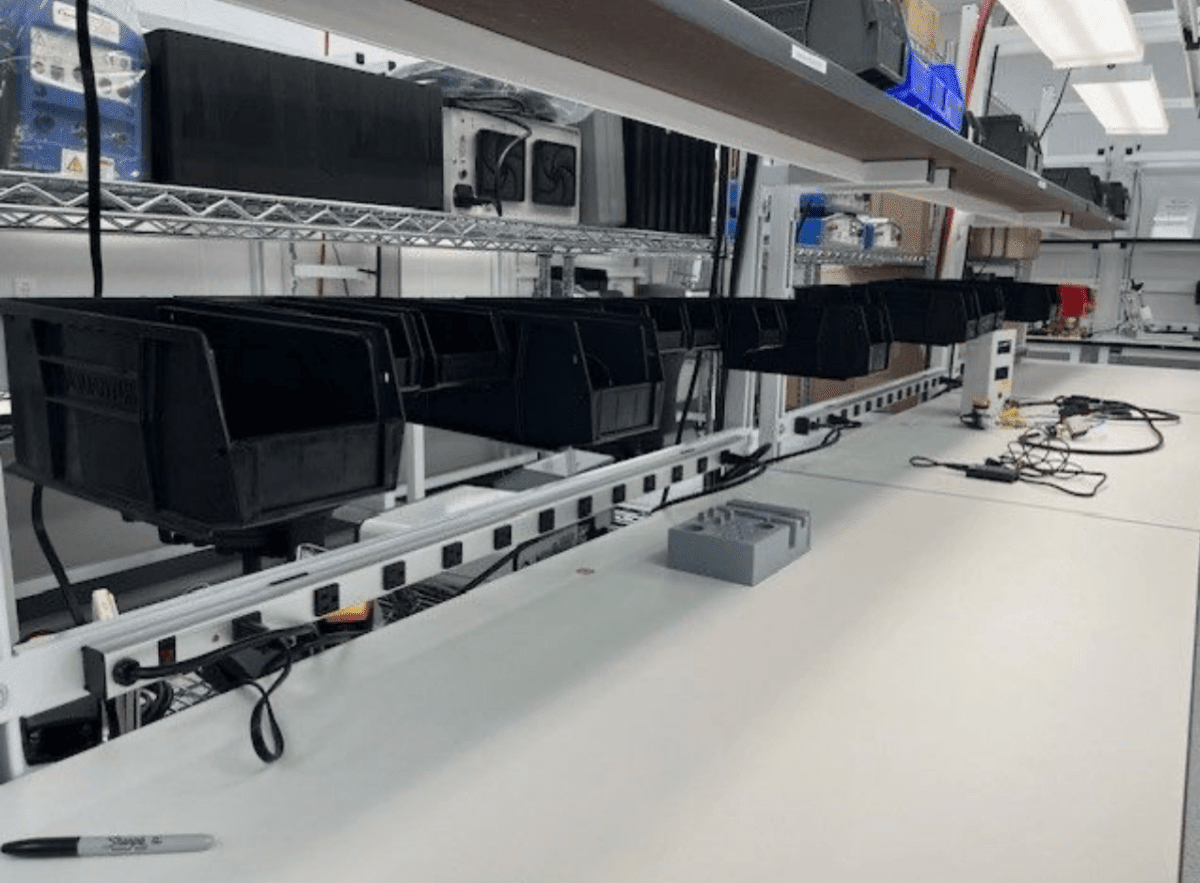
A workbench that works well in practice divides into four zones. Each zone has a primary storage type matched to how parts are accessed. Choosing the right bin for each zone is what separates a clean, audit-ready bench from one that technicians quietly work around.
Zone 1: Pick Zone (the operator's reach envelope)
The pick zone is everything within arm's reach of the seated or standing operator — typically the upper shelf and the back rail of the bench. This is where small parts are stored for continuous picking: ICs, passives, connectors, fasteners, consumables. Access needs to be one-handed and open-front, because operators will not unstack or open lids during a build, no matter what the SOP says.
ESD safe shelf bins are the correct storage type for this zone. Their open-front hopper design puts contents at the operator's fingertips, and the QSB-CO series sits on standard wire shelving or rail systems without special hardware. Use small sizes for passives and ICs, medium sizes for connectors and sub-assemblies, and optional dividers where a single bin needs to hold multiple part numbers.
Zone 2: Work Zone (the dissipative mat surface)
The work zone is the mat itself — the flat surface where actual assembly, test, or rework happens. Per ANSI/ESD STM4.1, the mat should measure between 106 and 109 Ω from surface to ground point, tested with a 5-pound electrode at two positions. The mat bonds to the common point ground through a pigtail that includes a 1-megohm current-limiting resistor — this is required to prevent injury if the operator contacts line voltage while wearing a wrist strap.
Keep the mat clear of long-term storage. Anything that sits on the mat for more than a few minutes should be on a grounded mat or inside a dissipative container.
Zone 3: Staging Zone (WIP in and out of the work zone)
The staging zone is the area immediately adjacent to the mat where boards, sub-assemblies, and kits sit before and after work steps. Boards in staging need compartmentalization to prevent board-to-board contact and mechanical damage.
ESD safe divider boxes (DG series) are the right choice for this zone. Adjustable length and width dividers let you create compartments sized for specific boards, and snap-on covers protect contents between operations. Populated assemblies especially benefit from divider-box staging, since standing components make stacking boards directly on top of each other a mechanical risk. For kitted parts that move between stations, the larger DG sizes with covers double as transport containers within the EPA.
Zone 4: Overflow and Transport Zone (between benches and to the line)
Larger part volumes, line-side kitting overflow, and anything moving between benches or to the assembly line belongs in stackable, hangable storage. ESD safe stacking bins (QUS-CO series) stack securely on carts, hang from grounded louvered panels, and interlock with each other so a full cart stays organized during movement. They're also the correct container for line-side replenishment of the pick zone — operators pull from stacking bins on the cart, refill shelf bins at the station.
At end of shift, or during facility cleaning, ESD covers and equipment blankets drape over the workstation to keep dust, airborne contamination, and ambient humidity from settling on exposed assemblies in the work or staging zones.
Grounding Topology: What Connects to What
Grounding is where most ESD programs quietly fail. The rule is straightforward: every conductive or dissipative surface at the workstation connects to the same single point, and that point connects to building ground. But "every surface" includes things most installers forget.
At a minimum, the common point ground at the bench bonds to:
- The dissipative mat on the work surface (through a pigtail with 1-MΩ current-limiting resistor)
- The operator's wrist strap (through a coiled cord with a 1-MΩ resistor)
- Any grounded tooling (soldering station, hot-air rework, programmers)
- The metal frame of the bench itself
- Any steel shelving above or behind the bench
- The bin rails or louvered panels that ESD bins hang from
- Any metal chair or stool used at the station
- The ionizer housing, if used
The common point then connects to building ground with solid copper, typically back to the same ground bus as the AC power circuit feeding the station. Continuity from the common point to building ground should measure under 1 Ω per ANSI/ESD S6.1. Anything above 1 Ω means a corroded or loose connection somewhere in the chain, and should be diagnosed before production runs.
The most common installation error is bolting ESD bins to ungrounded painted-steel shelving. Paint is an insulator. The shelving looks metal but electrically it's a capacitor. A ground strap from the shelving to the common point fixes this in about ten minutes per unit.
Personnel Grounding
Dissipative surfaces only protect parts when the operator at the bench is also at the same potential. Two methods are approved under ANSI/ESD S20.20:
Wrist Straps (Seated Work)
For any seated operation, a wrist strap is the primary personnel ground. The strap itself measures in the 105 Ω range against skin; the coiled cord carries a 1-MΩ safety resistor. Together the path from operator to common point stays inside safe discharge limits while draining charge fast enough to prevent accumulation. Wrist straps must be tested daily per ANSI/ESD S1.1 using a combination checker — this is non-negotiable for audit.
Heel Grounders + ESD Floor (Standing Work)
For standing operations, the operator wears heel grounders (one per foot, not just one) on dissipative ESD flooring. The combined system must measure less than 3.5×10⁷ Ω person-to-ground per ANSI/ESD STM97.1 (and under 100V of body voltage generation per STM97.2 as the operator walks around). Heel grounders fail silently when the tab works its way out of the shoe — daily test at a combination checker is the only reliable catch.
Ionizers: When You Can't Eliminate Insulators
Some insulators cannot be removed from the bench. Plastic monitor housings, keyboards, safety glasses, and certain jigs stay where they are because the work can't happen without them. Ionizers neutralize the static charge these insulators accumulate by flooding the air with balanced positive and negative ions.
Placement matters. An overhead ionizer should reach within 12 to 18 inches of the ESD-sensitive part surface, with a measured discharge time under 2 seconds from 1,000V to 100V per ANSI/ESD SP3.3. Ionizers further away lose effectiveness quickly, and ionizers placed too close to a charged monitor or plastic fixture can leave ion imbalance that actually charges components negatively. Verify discharge time and offset voltage with a charged plate monitor, not by feel.
Ionizers are a supplement, never a substitute. A station that depends on the ionizer to compensate for missing grounding or the wrong bin material will fail audit.
Environmental Controls
Need ESD-safe storage?
Conductive and dissipative bins, totes, and containers designed for electronics manufacturing and sensitive components.
Shop ESD StorageHumidity below 40% increases static generation from every surface in the room by an order of magnitude. Humidity above 60% creates corrosion risk on exposed copper and encourages condensation on cool components. The target band is 40% to 60% relative humidity, measured and logged continuously at the workstation level, not just at the building's HVAC setpoint.
EPA boundaries must be marked on the floor — yellow tape or painted border is standard — and entry points must carry the ESD warning symbol. Audit trails fail more often on missing signage than on missing equipment.
Pre-Production Verification
Before the bench goes into service, and on a defined audit cadence after that, verify each element:
| Test | Standard | Target | Frequency |
|---|---|---|---|
| Work surface resistance | ANSI/ESD STM4.1 | 106 to 109 Ω | Quarterly |
| Point-to-ground continuity | ANSI/ESD S6.1 | < 1 Ω | Quarterly |
| Wrist strap + cord | ANSI/ESD S1.1 | Pass on checker | Daily (operator) |
| Footwear + floor combined | ANSI/ESD STM97.1 | < 3.5×10⁷ Ω | Daily (operator) |
| Body voltage walking test | ANSI/ESD STM97.2 | < 100 V | Annually |
| Ionizer discharge time | ANSI/ESD SP3.3 | < 2 s (1000 to 100 V) | Semi-annually |
| Ionizer offset voltage | ANSI/ESD SP3.3 | ± 35 V | Semi-annually |
| Bin surface resistance | ANSI/ESD STM11.11 | < 1011 Ω/sq | Annually on sample |
| Humidity | Facility spec | 40–60% RH | Continuous |
Keep the records. Audit findings on ESD programs are almost always about documentation, not about the equipment itself.
Build Checklists by Operation Type
SMT Line-Side Workstation
- Dissipative mat bonded to common point ground
- Grounded wire shelving above the bench for ESD shelf bins holding 0402/0603 passives, QFNs, connectors
- Grounded rail behind the bench for ESD stacking bins with reel and tray overflow
- Feeder cart staging with stacking bins for tools between job changeovers
- Wrist strap at the seated operator position, daily test station within 3 feet
- Overhead ionizer positioned 15 inches above work surface
Board-Level Repair Bench
- Larger mat area to accommodate microscope, hot-air station, and oscilloscope
- All test equipment bonded to common point ground
- Shelf bins for component inventory (replacement ICs, capacitors, connectors)
- ESD divider boxes on adjacent rack for board WIP awaiting disposition, one compartment per serial
- Wrist strap plus heel grounders for operators who stand for probe work
Medical Device and Aerospace Assembly
- Cleanroom-compatible ESD flooring; carbon-black bins are pigment-free and cleanroom-acceptable
- Grounded shelving and dissipative work surface required for FDA/FAA audit
- Divider boxes for serialized sub-assemblies with lot traceability labels
- Shelf bins for fasteners, seals, and consumables at the bench
- Documented daily operator grounding tests tied to build records
- Ionizer placement validated with charged plate monitor, documented per build
R&D and Prototype Labs
- Modular bench uprights to reconfigure for changing project mix
- Broad mix of shelf bin sizes on rails for frequent part-number rotation
- Divider boxes for project-specific kits, one box per active project
- Stacking bins on mobile carts for parts that move between prototyping and test
- ESD covers over sensitive prototypes at end of shift
Common Workbench Configuration Mistakes
- Painted-steel shelving treated as grounded. It isn't. Add a ground strap from the shelf frame to the common point, or replace with unpainted wire shelving that is then bonded to ground.
- Mixing standard and ESD bins at the same station. One insulative bin inside the EPA can charge to thousands of volts and discharge into a board the operator moves past it. Standardize every bin at an ESD-sensitive station.
- No daily wrist strap test. Straps fail silently — the coiled cord breaks internally and the operator doesn't know until the quarterly audit. A checker at the station entry with a logged daily touch is the fix.
- Office chairs rolled into the EPA. Fabric upholstery and plastic arms are strong static generators. ESD chairs with conductive casters are the standard replacement.
- Cardboard boxes on the bench. Standard corrugate is insulative. Either remove all cardboard from the EPA or use ESD-safe corrugate for anything that enters.
- Ionizer used to "fix" missing grounding. Ionizers supplement a grounded system, they don't replace one. An auditor will catch this in about two minutes.
- No humidity monitor at the station. Building HVAC setpoint is not the same as workstation humidity. Monitor where the work happens.
Further Reading
- How to Build an ESD Storage Program for Electronics Manufacturing — program-level view of ESD storage across the facility
- PCB Storage in Electronics Manufacturing — board-level storage, MSD handling, and material selection
- Safe Storage and Transportation Solutions for Server Boards — high-value assembly transport outside the EPA
- ESD Safe Bins and Containers for Data Centers — facility-scale ESD storage for data center and hyperscaler operations
Build Your ESD Workbench with Industrial 4 Less
We stock every container and storage element a compliant ESD workbench needs, from the pick-zone shelf bins to the transport stacking bins, and we ship fast out of stock on every size. Whether you're configuring a single bench or rolling out a full production line, we can help you match bin sizes and configurations to your operation.
- Shop ESD Shelf Bins — the primary storage for the workbench pick zone
- Shop ESD Divider Boxes & Grid Containers — compartmentalized WIP and staging storage
- Shop ESD Stacking Bins — line-side kitting and overflow
- Shop ESD Covers — end-of-shift and facility-cleaning protection
- Browse All ESD Safe Bins & Containers
- Shop SMT Reel Shelving Units — paired reel storage for SMT lines
Need ESD-safe storage?
Conductive and dissipative bins, totes, and containers designed for electronics manufacturing and sensitive components.
Shop ESD Storage