
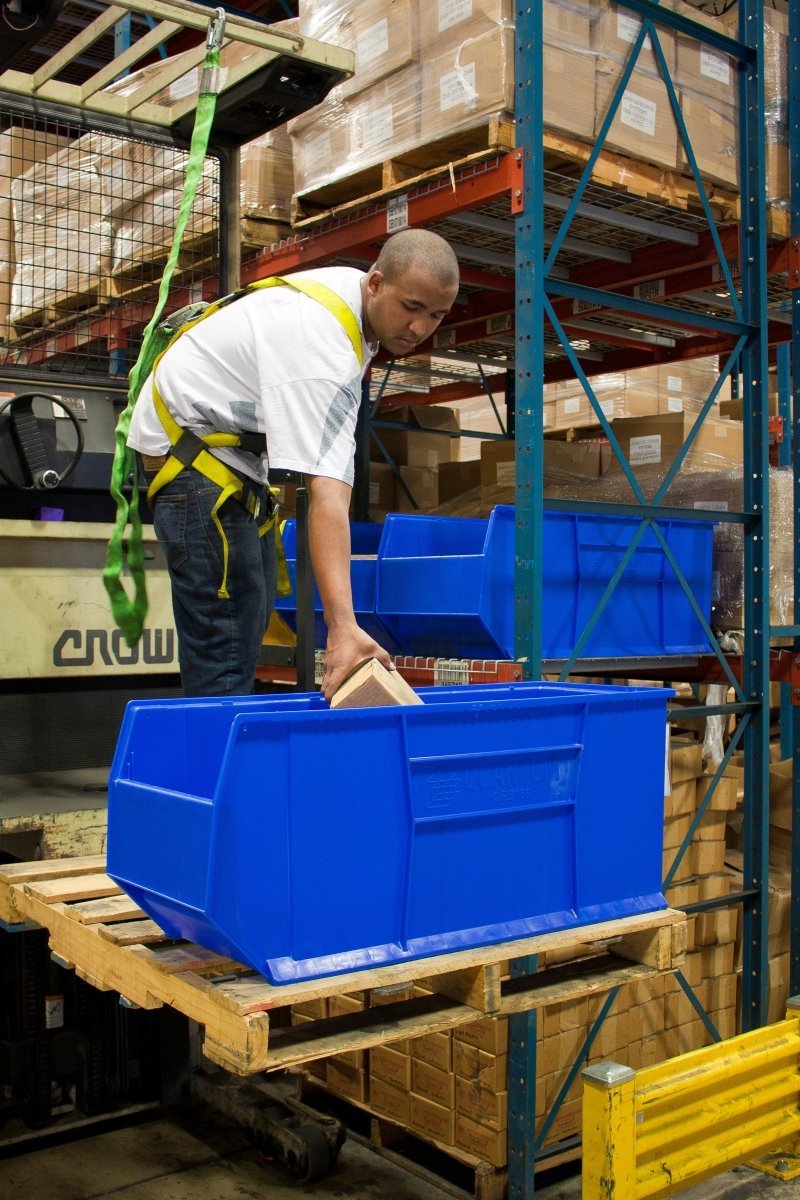
Choosing warehouse containers comes down to four factors: what you're storing, item size, item weight, and how often you access it. Open-front stackable bins suit high-pick-rate items, nesting shelf bins organize small parts, and stack-and-nest totes with covers handle heavy or automated loads. Once you've picked the container, match it to a shelving or rack system rated for the total weight.
Plastic storage containers are a versatile and cost-effective solution for storing a variety of inventory in your warehouse. Available in multiple sizes, shapes, and colors, these containers can be utilized to meet your specific storage needs. Their lightweight nature and ease of mobility make them ideal for high-traffic areas, enhancing operational efficiency.
Why use plastic storage containers in a warehouse?
Revisiting our previous post, "10 Benefits of Using Storage Bins in Your Warehouse", let's highlight some critical advantages of using plastic storage containers in your warehouse:
- Enhanced Organization: Keep your inventory systematically arranged, making it quicker to locate items, thereby saving time and reducing costs.
- Increased Safety: Prevent accidents by maintaining a clutter-free environment, with items neatly stored in containers.
- Damage Reduction: Protect your inventory from moisture, pests, and other environmental hazards.
- Operational Efficiency: Simplify the process of finding and moving items, boosting overall warehouse productivity.
What are the main types of warehouse storage bins?
Plastic shelf bins are versatile storage solutions designed to optimize organization and space utilization in your warehouse. The three workhorse types:
| Container type | Best for | Key feature | Access style |
|---|---|---|---|
| Open-front stackable bins | High-pick-rate items needing quick access & visibility | Open front or 4 equal walls; some include rear hangers for louvered panels/rails | Front-facing, instant visibility |
| Nesting shelf bins | Small parts & components | Up to 7 width-divider slots; nest empty to save space | Top access, customizable dividers |
| Stack & nest totes with covers | Heavy-duty loads, conveyors, automated systems | Durable; secure covered storage; nest when empty to reclaim space | Lidded; stack full / nest empty |
Each type offers distinct advantages: open-front stackable bins for fast picking and visibility, nesting shelf bins for organizing small parts and components, and stack-and-nest totes with covers for heavy-duty or automated handling. Matching the bin to how often you reach for the items — and how heavy they are — is the fastest way to cut pick times.


How do I choose the right warehouse container?
Choosing the right storage solutions for warehouses involves several considerations:
- Inventory Type: Ensure containers are appropriate for the items you are storing, especially for hazardous materials.
- Item Size: Select containers that are sufficiently large for your items.
- Available Space: Assess the spatial constraints of your warehouse to determine the suitable container sizes.
- Item Weight: Opt for containers designed to handle the weight of your inventory. Heavy-duty hopper bins handle dense parts and stack up to six high, while lighter bins suit small components.
- Security Needs: For valuable items, choose containers made of robust materials with security features.

How should I organize bins in a warehouse?
Maximize your warehouse efficiency by organizing your inventory effectively:
- Clear Labeling: Label each container to easily identify its contents.
- Grouping Similar Items: Store similar items together to streamline the search process.
- Color-Coding: Use different colors or labels for different sections of your warehouse to prevent confusion.
- Efficient Storage Methods: Stack containers on pallets or utilize shelving units to optimize space.
- Adequate Spacing: Ensure there is sufficient space between containers for easy navigation.
What shelving works with storage bins?
To create a comprehensive storage solution, pair plastic storage containers with suitable shelving units. Shelving units provide a sturdy foundation and help maximize warehouse space. Here are some popular shelving options:
- Pallet Racks: Ideal for storing large quantities of inventory, adjustable to fit various needs.
- Wire Shelving: Suitable for ventilated storage, such as food or clothing; durable and robust. Our NSF-certified chrome wire shelves are rated 600–800 lbs each (evenly distributed).
- Metal Shelving: A heavy-duty option perfect for hazardous materials or items needing extra protection.
When selecting shelving units, consider:
- Inventory Type: Ensure compatibility with the items being stored.
- Item Size and Weight: Choose shelving that can accommodate your inventory's size and weight.
- Security Needs: For valuable items, opt for durable shelving with security features.

Which industries use warehouse storage bins?
Warehouse storage bins are used across nearly every industry that handles parts, supplies, or tools.

- Manufacturing and Assembly: Bins help organize production lines and kitting stations, keeping materials accessible while maintaining lean operations.
- Automotive Warehouses: Store gaskets, fasteners, and replacement parts securely while maintaining SKU separation.
- Healthcare and Dental: Clear bins and tip-out drawers support sterile storage for instruments, gloves, and supplies.
- Construction and Trades: Mobile shelving with bins helps organize materials in trailers, reducing wasted time on job sites.
- E-Commerce and Fulfillment: Color-coded bins and shelving systems streamline order picking and restocking in busy fulfillment centers.

Future-Proof Your Warehouse Operations
The most expensive storage mistake is buying a mismatched assortment of bins that don't stack or nest together. Standardizing your container system now ensures that as your SKU count grows, your storage infrastructure scales with you seamlessly. Whether you choose heavy-duty stackable bins for heavy parts or nesting totes for return logistics, consistency is key to faster pick times and lower error rates.
Ready to standardize? We offer volume discounts for full-pallet orders. Browse our dedicated page on warehouse storage solutions and contact us for assistance or volume discount requests.
Common questions about warehouse containers
What's the difference between a bin and a tote?
A bin is typically open-front or open-top for fast picking on a shelf; a tote is a deeper, often
lidded container built to be moved, stacked, or run on conveyors. Use bins for access, totes for
transport and heavier loads.
Can plastic bins hold hazardous materials?
Our plastic bins are molded from high-density polypropylene — waterproof and resistant to rust and
corrosion — which is why they're used in pharmaceutical and chemical laboratory settings. For a
specific hazardous or reactive substance, confirm chemical compatibility for that chemical, and
choose a container with a secure cover, before storing.
How much weight can a wire shelving unit hold?
Our NSF-certified chrome wire shelving holds 600–800 lbs per shelf when the load is evenly
distributed (capacity varies by shelf size). Always distribute weight evenly and stay within the
per-shelf rating.